
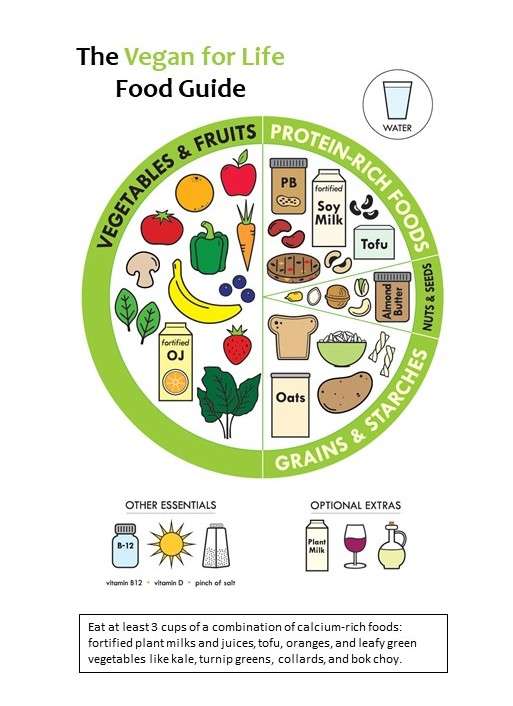
VEGAN FOOD GUIDE
When I worked on the American Dietetic Association’s Position on Vegetarian Diets back in 2003, my co-authors (Dr. Reed Mangels, RD and Vesanto Melina, M.S., R.D.) and I developed a food guide to accompany that paper. In the peer review process, 22 nutrition professionals looked at the guide, so it has been subjected to scrutiny by vegetarian experts.
This is a slightly tweaked version of the original, re-formatted, updated to reflect more current nutrition information and revised to be completely vegan. I’ve left it as a nice rectangle rather than a pyramid because it seems like pyramids become difficult to read at the top.
It’s not the final word on creating a healthful vegan diet. No one food guide represents the only or best way to meet nutrient needs. And you don’t need to follow these guidelines with meticulous attention every single day. You won’t keel over and die if one day you have only four servings of grains! I know that very few people actually follow food guides, but this is meant to give you some general direction for diet planning. Any set of guidelines for vegans needs to provide specific information about meeting needs for calcium, vitamins B12 and D, and iodine and so I’ve strived to do that at the very least.
The guide doesn’t include things like chocolate chip cookies, potato chips, and wine. That doesn’t mean you can’t have them. They just don’t fit into the food groups that should be at the center of your diet. Likewise, you can have the occasional serving of refined grains. I prefer white pasta to whole wheat for example. It’s fine, as long as most of the grains in your diet are unrefined.
Unlike other food guides, this one has no official “calcium group,” or “milk alternatives group.” But it also doesn’t simply ignore this nutrient, either. Small amounts of calcium from a variety of foods in all of the groups will add up to adequate calcium intake. As you make your choices from the food groups in this guide, include 6 to 8 servings of the foods that are rich in calcium. These are listed in the third column of the guide and each provides around 100 to 150 milligrams of calcium per serving. So if you consume ½ cup of calcium-set tofu, it counts as a serving from the Legumes group, and also counts as one serving toward your calcium-rich foods quota. Note that for soymilk, 1 cup equals a serving from the Legumes group but counts toward two calcium servings.
A note about milks: Many people prefer almond, rice or hemp milk to soymilk. If these milks are fortified, they are a great source of calcium. The problem is that they aren’t a great source of much else. They don’t really fit into the Legumes group, because they provide minimal protein. That doesn’t mean that you shouldn’t consume them. Just keep in mind that they are likely to displace more protein-rich foods in meals, so you’ll need to make adjustments accordingly.
VEGAN FOOD GUIDE
|
Food Group
|
Foods in This Group
|
Foods in This Group That Count as a Calcium-Rich Food
|
Notes
|
|
Grains and Starchy Vegetables
5 or more servings per day
|
½ cup cooked cereal, rice, pasta, quinoa, or other grain or potatoes, sweet potatoes, yams; 1 ounce of ready-to-eat cereal, 1 slice of bread, 1 small baked potato.
|
1 ounce calcium-fortified cereal.
|
Choose whole grains as often as possible.
|
|
Legumes, Soyfoods
3 or more servings per day
|
½ cup cooked beans,½ 1/ 2 cup calcium-set tofu, ½ cup tempeh, 1 ounce veggie meat, 1 cup fortified soymilk.
|
½ cup fortified soymilk, ½ cup tempeh, ½ cup calcium-set tofu (look for calcium-sulfate on the label), ¼ soynuts, ½ cup soybeans.
|
|
|
Nuts, Seeds
1-2 servings per day
|
¼ cup nuts, 2 tbsp seeds, 2 tbsp nut or seed butters
|
¼ cup almonds, 2 tbsp almond butter or tahini.
|
|
|
Vegetables
4 or more servings per day
|
½ cup cooked vegetables, 1 cup raw vegetables, ½ cup vegetable juice.
|
½ cup cooked or 1 cup raw bok choy, broccoli, collards, Chinese cabbage, kale, mustard greens, okra. ½ cup calcium-fortified tomato or vegetable juice.
|
Aim for at least 2 servings per day of leafy greens—especially the calcium-rich ones.
|
|
Fruits
2 or more servings per day
|
1 medium fresh fruit, ½ cup cut-up fruit, ¼ cup dried fruit, ½ cup fruit juice.
|
¼ cup chopped dried figs, ½ cup calcium-fortified fruit juice.
|
|
|
Fats
Be sure to meet needs for the essential omega-3 fatty acid (see sources on the right). Otherwise, there is no need for additional fats in your diet, but it’s fine to have a few servings every day.
|
1 tsp vegetable oil, vegan margarine, or vegan mayonnaise.
|
|
To meet needs for alpha-linolenic acid, include 3-4 servings per day from this list:
1 tsp canola or walnut oil or ground flaxseed; 2/3 tsp hempseed oil; 1 walnut; 1/4 tsp flaxseed oil; 1/2 cup cooked soybeans;
1 cup firm tofu or tempeh; 2 tbsp soynuts
|
The food guide does not ensure that you will get enough vitamin B12, iodine, and vitamin D. So…
- Make sure that your food choices include:
- 2-3 servings per day or foods fortified with vitamin B12 OR
- A daily chewable B12 supplement providing at least 25 micrograms OR
- A twice weekly chewable supplement providing 1,000 micrograms.
- Be sure you are also getting at least 1,000 IUs (25 micrograms) per day of vitamin D through supplements or fortified foods unless you are certain that you have adequate sun exposure.
- If you don’t use iodized salt—about ¼ teaspoon per day—it’s a good idea to take an iodine supplement.
- You might want to take a small supplement—200 to 300 milligrams per day—of a vegan DHA supplement. The jury is still out on whether this is important or not.


Recent Comments