
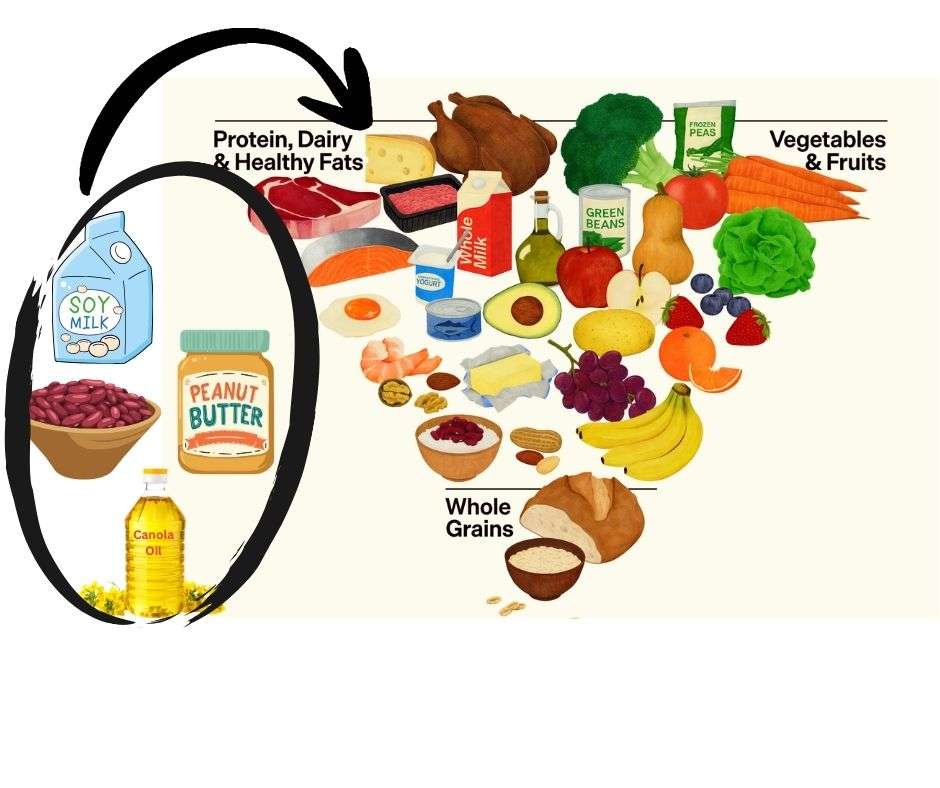
The Dietary Guidelines Advisory Committee spent two years rigorously reviewing the evidence, holding public meetings, and inviting public comment. When their findings were dismissed by HHS Secretary Robert F. Kennedy, Jr., he explained that it was because “all scientific questions were evaluated through a health equity lens.” According to Kennedy, this led the Committee to “consistently advocate plant-based dietary patterns, deprioritize animal-sourced proteins, and favor high linoleic acid vegetable oils.”
In response, RFK Jr. hastily assembled his own group of reviewers, who quickly produced the dietary recommendations released last week. These new guidelines are a clear gift to the meat and dairy industries. They are also sloppy, illogical, and retrograde.
Despite boasting that the recommendations are “free from ideological bias, institutional conflicts, or predetermined conclusions,” the opposite is true. The guidelines transparently reflect Kennedy’s own ideological commitments and long-held beliefs about food.
What struck me, too, when reading the consumer-facing materials was how embarrassingly amateurish they felt for official government publications. Inconsistencies in language and recommendations make the entire project look like something a college student rushed to finish the night before it was due.
I know this is the point in the critique where I’m supposed to acknowledge what the guidelines get right, so here it is: yes, it’s good—though hardly groundbreaking—that the guidelines suggest eating more whole foods and fewer Twinkies. Unfortunately, from there, the advice quickly devolves into contradictions and outright errors.
The most obvious contradiction is the recommendation to prioritize high-fat animal foods while keeping saturated fat intake below 10% of calories. This is next to impossible. Consuming the recommended three daily servings of full-fat cow’s milk, plus three ounces of beef, plus a tablespoon of RFK Jr.’s beloved beef tallow (yes, beef tallow is explicitly recommended as a cooking fat) on a 2000 calorie diet would push most people past the 10% limit before they’d consumed even half their calories.
The text accompanying the guideline graphic does mention plant protein sources like beans and tofu. The graphic itself, however, barely acknowledges them. There’s a walnut, an almond, a peanut, and a small pile of what appear to be kidney beans. These sit beneath an entire roasted chicken (or maybe it’s a turkey), a quart of cow’s milk, a can of tuna, a large wedge of cheese, and a steak roughly the size of a loaf of bread. The intention to prioritize animal foods couldn’t be clearer.
Some guidance is simply incorrect. For example:
“When cooking with or adding fats to meals, prioritize oils with essential fatty acids, such as olive oil. Other options can include butter or beef tallow.”
None of these fats are meaningful sources of essential fatty acids. The best sources are walnuts, flax and chia seeds, and canola and soy oil. But the last two are seed oils—and one of RFK Jr.’s firmly held beliefs is that seed oils are harmful, despite substantial evidence to the contrary. Their omission reflects bias and personal agenda. The claim about olive oil, meanwhile, is just careless.
If these guidelines are poor advice for the average American, they are essentially useless for vegans. Where are the alternatives to cow’s milk? Even the Academy of Nutrition and Dietetics has publicly criticized this omission, so it’s not just me being a whiny vegan. The list of plant-based calcium sources included in previous guides has simply disappeared.
Soy milk was almost certainly dropped because it’s considered “processed” and sometimes contains added sugar. This is a prime example of philosophical bias overriding science. While we don’t have mountains of data, some evidence suggests that soy milk consumption reduces risk factors for heart disease and may offer protection against breast cancer. Allegiance to so-called “real food” isn’t always aligned with better health outcomes.
And of course, vegans aren’t the only people who avoid cow’s milk. What about those with lactose intolerance, or people whose cultural food traditions include little or no dairy? Addressing the needs of diverse populations is clearly off-limits for this administration, and the guidelines faithfully reflect that exclusion.
The guidelines also incorrectly list vitamin E, niacin, vitamin B6, magnesium, phosphorus, and potassium as potential shortfalls in vegan diets. It’s an irresponsible error. The mistake stems from a modeling exercise that removed eggs and dairy from a healthy vegetarian diet without replacing them with appropriate alternatives. When fortified soy milk is used instead, the list of deficiencies shrinks considerably. Notably, the reviewer responsible for this section—who has a strong pro-animal-food bias—acknowledged the error after it was pointed out on social media.
None of this is to say that vegan diets have no potential nutrient shortfalls. Vegans should pay attention to calcium, zinc, iron, iodine, and vitamins D and B12. But the new dietary guidelines offer no practical help beyond vague suggestions to use supplements. The reality is that this group had neither the interest nor the expertise to provide meaningful guidance for nutritionally adequate vegan diets.
Maybe these failures are the result of simple incompetence and sloppiness. But given the viewpoints of RFK Jr. and his hand-picked experts, it’s hard not to suspect a broader agenda – one that doesn’t include a commitment to a kinder and healthier planet or the health of all people.
I’d like to say that none of this matters to vegans. After all, we have access to excellent resources for planning healthy diets, and most reasonable people will dismiss nutrition advice coming from RFK Jr. Still, these guidelines represent a setback for public health, the planet, and animals.
It’s good, though, to see the deficiencies of these dietary guidelines being exposed by voices far more impactful than mine. In the meantime, I plan to keep doing what I’m doing: speaking out on behalf of farmed (and all) animals and the planet and continuing to share evidence-based information about healthy vegan diets while challenging misinformation wherever it appears.
Discover more from The Vegan RD
Subscribe to get the latest posts sent to your email.
Thank you so much for this great summary. I couldn¨t help laughing loud at some of your made points in the article. Yes, let us continue to do what we have been doing for our planet, the animals and our health. Kindest regards.
Thank you for summarizing all that is wrong with this food guidance. I think about the poor school children who will be adding more fat, meat and cheese to their lunches. And what about the WIC program? These new moms and babies need proper nutrition. It is so sad. Definitely looks like we are going backwards in so many ways.
Thanks for the update.
Thanks for your thoughtful, unbiased post.
It’s all about the money. The meat and dairy industries spend billions promoting their products. This is done with aggressive advertising and lobbying campaigns. The American people are the most propagandized people on Earth. And it shows. Americans are ignorant about both what’s on their dinner plate and geopolitics. Don’t expect anything truthful to come out of the Trump administration.